Research Preview · First of its kind

The Arabic AI‑GPR Index

A daily measure of geopolitical risk built from Arabic‑language news, read and scored with large language models — the first geopolitical risk index constructed from the Arab world’s own media. Updated every month.

2015–2026
Daily coverage
4,117
Days indexed
~16M+
Arabic articles screened
20
Curated outlets
Live series

Geopolitical risk, 2015–2026

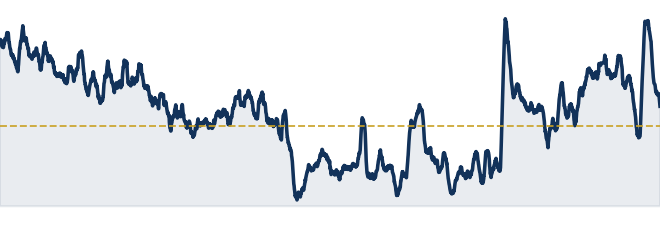
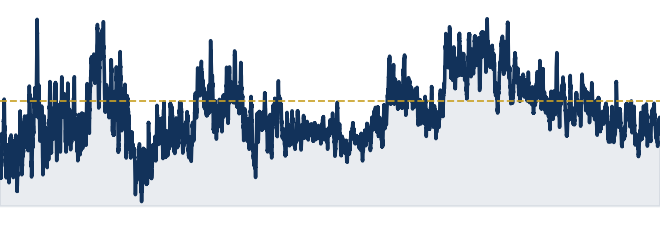
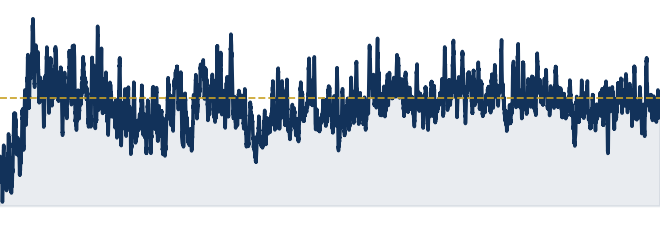
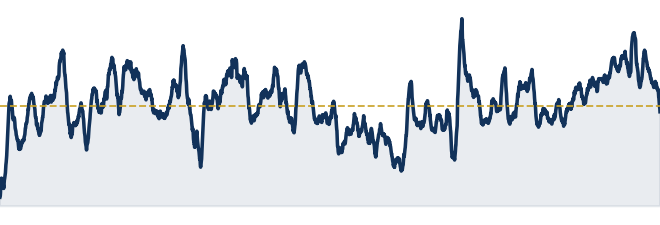
Move your cursor across the chart to read the index day by day. Drag to zoom, use the slider below to pan, or the buttons to jump to a period. Dashed lines mark major events. The series is refreshed every month with the latest data.

Daily index (light) with a 30‑day average (bold), normalized so the 2016–2024 mean = 100. Source: GDELT Arabic articles, curated outlets. Peak: 169 on 13 Jun 2025.
LLM version — coming soon

What you see above is the fast, theme‑based baseline. It reads GDELT’s geopolitical tags directly — no web‑scraping, no AI — which makes it fully transparent, reproducible, and refreshed every month. And it already tracks the region’s major shocks remarkably well.

But the real breakthrough is on its way: a full LLM‑based index in which artificial intelligence reads every single article and scores its geopolitical‑risk intensity — faithfully following Iacoviello & Tong (2026). Early results are striking: it is dramatically sharper, distinguishes a passing mention from a front‑page crisis, and catches virtually every major event — outperforming the keyword‑based approach. This is the most powerful Arabic geopolitical‑risk measure built to date. Stay tuned.
Roadmap

More coming soon

The headline index is just the start. The same Arabic‑LLM pipeline is being extended both backward through earlier decades — toward the longest Arabic geopolitical‑risk record — and outward into a full family of measures.

Live
📊

Headline Arabic AI‑GPR

Daily index of geopolitical risk from curated pan‑Arab news, 2015–present.

Soon
🤖

Full LLM‑scored version

The flagship. An AI reads every article and scores its risk intensity — far sharper than keyword counting, and catching virtually every event. The most powerful version yet.

NEW
🌍

Country‑level GPR

Separate risk series for every country named in the news — Saudi Arabia, Egypt, Iran, Israel, and more. Now live and interactive.

Explore the interactive page →
NEW
⚔️

Event categories

Sub‑indices by type: wars, terrorism, military activity, protests, sanctions, nuclear — now live and interactive.

Explore the interactive page →
NEW

Threats vs. acts

Anticipated risk (threats) versus realized events (acts), with a kinetic ratio — now live and interactive.

Explore the interactive page →
NEW
🤝

Bilateral country pairs

Co‑mention tension series for pairs — Iran–Israel, Saudi–Yemen, Israel–Lebanon — plus a who‑with‑whom heatmap. Now live.

Explore the interactive page →
NEW
🎯

By actor

Risk attributable to armed groups (Hamas, Hezbollah, Houthis) and named leaders (Netanyahu, Khamenei) — now live.

Explore the interactive page →
NEW
🏙️

City hotspots

Sub‑national hotspots — Gaza, Aleppo, Sana'a, Baghdad and more — now live and interactive.

Explore the interactive page →
NEW
🛢️

Oil & energy GPR

Energy‑supply risk by corridor (Persian Gulf, Red Sea, Suez), validated against Brent crude — now live.

Explore the interactive page →
Soon
🕒

Decades of history

Extending the index back through earlier decades to build one of the longest Arabic geopolitical‑risk series available.

How it’s built

Methodology

Following Iacoviello & Tong (2026), adapted end‑to‑end to Arabic news.

1
📰

Collect

Millions of Arabic‑language articles from leading pan‑Arab outlets, via the GDELT global news database.

2
🤖

Screen & read

Filter to geopolitical content, then have AI assess each article’s risk intensity on a 0–1 scale.

3
📈

Aggregate

Average daily, normalize to a 2016–2024 baseline of 100, and validate against known events.

Under the hood

What the index looks for

Every article is screened for geopolitical content using these conflict‑related categories. They orbit continuously — move your cursor across the sphere to spin it, and hover a term to see its English label and share.

Word size reflects how often each category appears across the Arabic corpus.
Your input matters

Expert feedback welcome

This index is a work in progress. If you are a researcher, analyst, or practitioner, your feedback — on the methodology, the choice of sources, the events captured, or anything that could improve its quality and accuracy — is genuinely valued and helps make it better.

Opens your email app to send — nothing is stored on this site.
❤️
Support the initiative

An independent effort — help keep it alive and free

The Arabic AI‑GPR Index is built and maintained single‑handedly by its author, Karim Iddouch — with no institutional funding, no grant, and no team. Behind every point on the chart lie long months of work: gathering and screening millions of Arabic news articles, reading and scoring them with AI, validating the series against more than a decade of regional events, and rebuilding it every single month.

It is offered openly, as a public resource for researchers and the curious alike. Your support keeps it independent, free to explore, and continuously updated — and directly funds the AI‑scoring compute, the data, and the ongoing extension of the record back across earlier decades. Every contribution, however small, genuinely moves the project forward.

16M+articles processed
4,100+days indexed
Monthlyupdates, by hand
1researcher
100% independent research · built, funded, and run by the author
Cite & FAQ

How to cite

If you use the Arabic AI‑GPR Index in your research, please cite it as:

Iddouch, K. (2026). The Arabic AI-GPR Index: Measuring Geopolitical Risk using Artificial Intelligence and Arabic-Language News. Research preview.
@misc{iddouch2026arabicgpr, author = {Iddouch, Karim}, title = {The Arabic AI-GPR Index: Measuring Geopolitical Risk using Artificial Intelligence and Arabic-Language News}, year = {2026}, note = {Research preview} }

Frequently asked questions

What is geopolitical risk?

The threat and realization of adverse events such as wars, terrorism, and tensions between states. Because it cannot be observed directly, it is measured from how intensively the news discusses it.

Why an Arabic‑language index?

Existing indices read global tension through English‑language, mostly Western newspapers. This index captures how geopolitical risk is perceived and reported within the Arab world itself — often earlier and in greater detail for regional events.

What are the sources?

A curated set of leading pan‑Arab news outlets, accessed through the GDELT global news database and filtered to Arabic‑language articles.

How is the index built?

In two layers: a fast, transparent theme‑based baseline (shown on this page) that reads GDELT’s geopolitical tags, and a forthcoming LLM‑based version in which AI reads and scores each article’s risk intensity, following Iacoviello & Tong (2026).

How often is it updated?

Every month, with the latest available data.

Can I access the underlying data?

Yes. The headline index and every sub‑index are free to download as CSV on the data page. The full article‑level corpus and replication code are available to researchers on request.